Pros of DBMS | Simplify Data Handling Fast
Published: 28 Sep 2024
Have you ever struggled to manage large amounts of data in your business or personal projects? Storing files in spreadsheets or scattered folders can lead to errors, slow work, and lost information. This is where a Database Management System (DBMS) becomes a lifesaver.
With a DBMS, you can store, organize, and access your data efficiently, saving both time and effort. Imagine having all your information in one secure place, easy to retrieve, and safe from mistakes. Here, we will look at the main benefits of a DBMS and explain how it helps manage data easily, reduces errors, and increases efficiency.
Whether you run a small business or handle complex projects, understanding these benefits can transform the way you work with data and make your operations smarter and faster.
What are the Advantages of a DBMS?
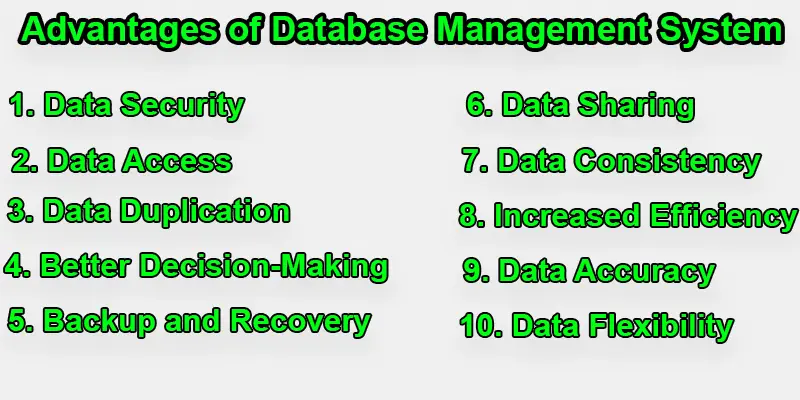
A Database Management System (DBMS) is software that organizes, stores, and lets you access data quickly and easily. It is used by businesses, schools, banks, and even small projects. Here are the main advantages of a DBMS in simple terms:
- Data Organization
- Data Security
- Data Integrity
- Data Sharing
- Data Backup and Recovery
- Reduced Data Redundancy
- Data Consistency
- Easy Data Access
- Centralized Control
- Improved Data Management
Data Organization
DBMS keeps data well organized in tables. This makes it easy to find and manage information. For example, a school can store student records in one place and quickly search any student’s details.
Data Security
DBMS provides strong data security. It ensures that only approved users can view and use the data. For example, in a bank system, only employees can see sensitive customer information. This helps protect data from unauthorized access.
Data Integrity
DBMS ensures that data is accurate and correct. It uses rules to avoid errors. For example, a system will not allow entering a negative age. This keeps the data reliable and trustworthy.
Data Sharing
A DBMS lets many users work with the same data at the same time. This makes teamwork easier. For example, in an office, different departments can use shared data without making copies.
Data Backup and Recovery
DBMS supports backup and recovery features. If data is lost or deleted, it can be restored easily. For example, if a system crashes, important files can be recovered from backup.
Reduced Data Redundancy
DBMS avoids duplicate data. It stores data in one place instead of multiple copies. For example, instead of saving the same customer info again and again, it keeps a single record. This saves storage space.
Data Consistency
DBMS keeps data consistent across the system. When one record is updated, all related data is also updated. For example, if a customer changes their phone number, it updates everywhere in the system.
Easy Data Access
DBMS makes it easy to access data using simple queries. Users can quickly search, update, or delete data. For example, a user can find product details in seconds using a search command.
Centralized Control
DBMS keeps all data in one central system. This gives better control and management. For example, a company can monitor all its departments from one database system.
Improved Data Management
DBMS improves overall data handling. It makes storing, updating, and retrieving data faster and easier. For example, businesses can manage large amounts of data without confusion or errors.
What are the Advantages of Database Systems Over Traditional File Systems?
Database systems (DBMS) are modern ways to store and manage data. They are much better than traditional file systems like folders and text files. Let’s look at the key advantages in simple terms.
- Better Data Organization
- Less Data Duplication (No Repetition)
- Easy Data Access and Search
- Improved Data Security
- Data Consistency and Accuracy
- Backup and Recovery
- Multi-User Access
- Reduced Data Inconsistency

Better Data Organization
A database keeps data in a structured way using tables. Each table has rows and columns. Example: A school database stores student names, marks, and fees in separate tables. This makes data easy to find and manage.
Less Data Duplication (No Repetition)
In file systems, the same data is often stored many times. This wastes space. A database reduces duplicate data by storing it only once. Example: In a file system, a student’s address may be saved in many files. In a DBMS, it is stored once and linked where needed.
Easy Data Access and Search
Databases allow fast searching using queries. You can find data quickly without opening many files. Example: A bank can quickly find your account details by entering your account number.
Improved Data Security
DBMS provides strong security features. You can control who can see or edit data. Example: Only a manager can access salary data, while other employees cannot.
Data Consistency and Accuracy
A database keeps data consistent. If you update data in one place, it updates everywhere. This avoids confusion and mistakes. Example: When a customer updates their phone number, it changes in all records automatically.
Backup and Recovery
Database systems provide backup options. If data is lost, it can be restored easily. File systems do not have strong recovery options. Example: If your computer crashes, a DBMS can recover lost data.
Multi-User Access
Several users are able to use the database at once without any problem. This is useful for offices and businesses. Example: In a hospital, doctors, nurses, and staff can use the same system together.
Reduced Data Inconsistency
Since all users access the same data, there is less chance of conflicting information.
Final Thought
A DBMS offers faster data access, improved accuracy, better security, and easier management of large datasets. These advantages make it a powerful tool for businesses and individuals who want reliable and organized data handling. By adopting a DBMS, you can save time, reduce errors, and make smarter decisions based on accurate information. Start exploring DBMS solutions today to take control of your data and streamline your workflow. With the right system, managing data becomes simple, efficient, and stress-free.
FAQS
What is the biggest benefit of using a database?
The main advantage of using a database is that it facilitates efficient management of massive volumes of data, making information easy to access and change.
How does a DBMS provide more benefits compared to a regular file system?
A DBMS provides more benefits than a regular file system by offering better security, less data duplication, easier access to information, and the ability for multiple users to work together on the same data at the same time.
Why is a DBMS important for improving data management and security in today’s businesses?
A database management system (DBMS) organizes data, lowers error rates, and ensures that only authorized individuals can access critical information. Thus, it is essential for enhancing data management and security.
What is DBMS and its functions?
DBMS stands for Database Management System, which stores and organizes data. Its main functions include data storage, retrieval, updating, and deletion.
What are the 4 features of a database?
Key features include data security, data integrity, reduced redundancy, and multi-user access. These features help manage data efficiently.






- Be Respectful
- Stay Relevant
- Stay Positive
- True Feedback
- Encourage Discussion
- Avoid Spamming
- No Fake News
- Don't Copy-Paste
- No Personal Attacks
- Be Respectful
- Stay Relevant
- Stay Positive
- True Feedback
- Encourage Discussion
- Avoid Spamming
- No Fake News
- Don't Copy-Paste
- No Personal Attacks
