What are the Advantages and Disadvantages of Computer?
Published: 6 Feb 2024
Have you ever thought about how computers make life easier, but also sometimes create problems? Today, computers are used in schools, offices, hospitals, and homes. They help us study, work, shop, and connect with others in seconds. But at the same time, many people also face issues like distraction, health problems, and over-dependence on technology. This is why understanding computer pros and cons is very important for everyone.
In this guide, you will learn about both sides of computers in a very simple way. You will see how computers improve speed, accuracy, and productivity in daily life. You will also understand their negative effects, like screen addiction, privacy risks, and reduced physical activity. Knowing both sides helps you use technology in a smarter and safer way.
This topic is useful for students, professionals, and everyday users who want to make better decisions while using technology. Instead of blindly depending on computers, you will learn how to balance their use. By the end, you will clearly understand when computers help you and when they can cause problems. Let’s explore the real advantages and disadvantages of computers in a simple and practical way.
What are the Advantages of the Computer?
One of the major advantages of computers is their ability to quickly and accurately perform tasks. They help us write, calculate, and organize information, saving time and effort. Here, we will discuss some advantages that are as follows:
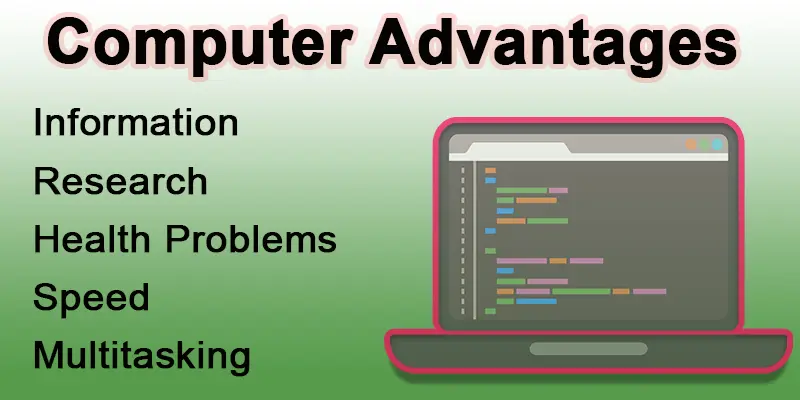
- Multitasking
- Improved Comprehension of the Facts
- Speed
- Privacy
- Social media
- Research
- Information of Computer
Information of Computer
Computers provide many advantages when it comes to accessing and managing information. They allow us to store large amounts of data, like documents, photos, and videos, in an organized way. We can quickly find and retrieve any information we need with just a few clicks.
Research
Computers offer many advantages for research. They allow researchers to quickly find and access a huge amount of information from around the world through the internet. This makes gathering data, reading studies, and staying updated on the latest discoveries easier.
Social media
Computers have greatly enhanced the use of social media, offering several advantages. They make it easy to stay connected with friends and family, no matter where they are. We can share photos, videos, and life updates on social media.
Privacy
Computers can offer several advantages when it comes to privacy. They allow us to store personal information securely using passwords and encryption, which helps protect our data from unauthorized access. With the right security settings and software, we can control who sees our information and what we share online.
Speed
The computer is now more than just a tool for calculations. These days, computers are important to human existence. One of their greatest advantages is the speed at which computers operate; it allows humans to do their work quickly.
Multitasking
One of the key benefits of computers is their ability to multitask. A computer can perform several tasks simultaneously, calculating numerical problems in seconds. The computer system can complete millions or billions of tasks in a single second.
Improved Comprehension of the Facts
Computers have created many tools for finding and understanding data. Organizations use these tools to analyze data better and create visual displays, which help them make better decisions.
What are the Disadvantages of a Computer?
While computers have many benefits, they also have some disadvantages. The biggest problem is that using computers for a long time can cause health problems like eye strain and back pain. Here, we will discuss some disadvantages that are as follows:
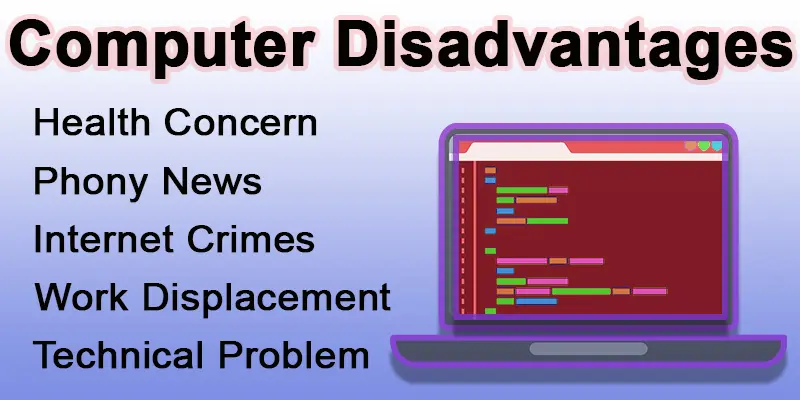
- Phoney news
- Internet-Based Crimes
- Health Concern
- Work Displacement
- Technical Problem
- Dependence on Computers
- Decrease the Job Opportunities
- Environmental Impact
Phoney news
Computers make numerous ways of sharing data possible. However, fake news can be shared using this media, and when false information is shared among users, innumerable cases are filed.
Internet-Based Crimes
Computers can experience cyber and hacking threats just like any other gadget. Data theft is one of the biggest risks in advanced computers. It could happen online or through a detachable offline device like a USB.
Health Concern
Continually using computers can result in a variety of health risks. An excessive amount of screen time causes eye strain and dry eyes. Additionally, extended sitting causes neck, back, and health difficulties.
Work Displacement
One disadvantage of computers is that they can replace people in some jobs, leading to work displacement. For example, tasks that were once done by humans, like data entry or manufacturing, can now be done by computers and robots.
Technical Problem
Computers can have technical problems that cause frustration and obstacles. Sometimes, they freeze or crash, causing unsaved work to be lost. Issues like slow processing speed or software errors can also slow down work and cause delays.
Dependency on Computers
One disadvantage of computers is becoming too dependent on them. When we rely heavily on computers for everyday tasks, we might need help if they break down or face problems. This dependency can make us less capable of doing things manually or without technology.
Decrease the Job Opportunities
The previous generation did not spend money on computers or need the quality of computers, so when computers came into the field, they faced a huge challenge.
Environmental Impact
Computers can hurt the environment in several ways. One important issue is electronic waste, or e-waste, which is generated when old computers and electronics are thrown away. These devices contain harmful substances like water, harming plants, animals, and humans etc.
Conclusion
Computers have both good and bad sides. They make work faster, improve learning, and support communication. At the same time, they can cause health issues, distractions, and privacy risks if not used wisely. Understanding computer advantages and disadvantages helps you use technology in a balanced and smart way. Always try to use computers for productive tasks and limit unnecessary screen time. Stay aware of digital safety and build healthy usage habits. Keep learning how to use technology in a positive way, and make your daily life more efficient and secure.
FAQs
What are the advantages and disadvantages of computer-aided design?
Efficiency: CAD speeds up the chart process, allowing for iterations and modifications.
Precision: Designs created in CAD are highly accurate and can be scaled without loss of detail.
Data Storage: Design files can be easily stored, shared, and regained, improving organization and accessibility.
Lack of Physical Feedback: Unlike traditional drafting, CAD lacks the tactile feedback of pencil on paper, which some designers find necessary for certain jobs.
Statistics Loss: If a network loss occurs, there is a heavy risk of data loss if permissible backup measures are not in place.
Potential for Viruses: Network transmission is a pathway for spreading viruses and malware if not properly protected.
What are the advantages and disadvantages of computer networks?
Resource Sharing: Networks allow the distribution of resources, such as monitoring printer files and internet connections, optimizing efficiency.
Communication: Facilitates communication through emails, moment messaging, and video conferencing, improving communication and information exchange.
Cost Efficiency: Allotting resources and centralized management lead to cost savings, eliminating hardware, software, and services.
What are the advantages of a desktop?
Customization: Users can build custom desktop configurations by choosing components that meet their requirements and preferences.
Expandability: Desktops must have more ports and expansion slots, making connecting peripherals and adding additional hardware components easier.
Cooling: Larger chassis and better cooling systems in desktops help manage heat more efficiently, preventing overheating and ensuring maintained performance.
Comfort: Desktop setups most come with ergonomic peripherals like big monitors, full-sized keyboards, and ergonomic mice, which supply a more comfortable working or gaming environment.
Repairability: Desktops are normally easier to mend and troubleshoot due to their modular nature, allowing users to replace or upgrade individual components without replacing the entire system.



- Be Respectful
- Stay Relevant
- Stay Positive
- True Feedback
- Encourage Discussion
- Avoid Spamming
- No Fake News
- Don't Copy-Paste
- No Personal Attacks
- Be Respectful
- Stay Relevant
- Stay Positive
- True Feedback
- Encourage Discussion
- Avoid Spamming
- No Fake News
- Don't Copy-Paste
- No Personal Attacks
